

Precision cooling that keeps your mission-critical data centre infrastructure running
As a colocation or cloud data centre provider in Australia or New Zealand, you're navigating surging compute densities, evolving customer SLAs and growing sustainability mandates, all of which put new pressure on your data centre cooling.
At STULZ, we engineer precision cooling solutions that are modular, high-density ready and optimised for energy efficiency, whether you're building hyperscale data centre campuses or edge data centres.

Key challenges in colocation and cloud data centre cooling
- High-density compute loads
- Speed-to-market
- Energy and sustainability pressures
- Uptime and reliability
- Global service availability
- Product flexibility
- Scalability requirements
From challenge to solution: colocation data centre cooling systems that fit your needs
-
High-density and liquid cooling for AI, GPU and HPC workloads
STULZ delivers advanced air and liquid cooling technologies for high-density applications, including in-row and rear-door units, direct-to-chip cooling and immersion cooling, engineered to handle the extreme thermal demands of AI, GPU and HPC environments in liquid-cooled data centres. -
Accelerated speed-to-market with pre-engineered cooling systems
With a global manufacturing network across Europe, Asia, North and South America, STULZ ensures rapid product availability and deployment. Pre-engineered systems enable fast integration into existing infrastructures, helping colocation and cloud providers meet tight timelines. -
Energy-efficient data centre cooling with free cooling and low-GWP refrigerants
STULZ data centre cooling solutions are engineered for maximum energy efficiency and environmental sustainability. They incorporate Free Cooling, adiabatic cooling, low-GWP refrigerants and Liquid Cooling technologies, helping colocation and cloud providers lower PUE and meet ESG compliance targets. -
Redundant cooling systems for maximum data centre uptime
To ensure continuous operation, STULZ data centre cooling systems are engineered with intelligent control, premium components and robust design. Features and services like redundancy concepts, remote monitoring and predictive maintenance enhance reliability across distributed sites, enabling data centres to maintain high availability. -
Global presence with local support across Australia and New Zealand
With a network of over 150 partners worldwide, STULZ ensures seamless global coverage backed by local technical support teams in Australia and New Zealand. Wherever your data centre operates, you benefit from expert service, genuine spare parts and fast response times, keeping your cooling infrastructure reliable and efficient. -
Flexible product portfolio
Whether you need standardized units for rapid deployment or fully customized solutions for complex requirements, STULZ offers a highly flexible product range. Designed with agility and precision, our cooling systems can be tailored to meet diverse infrastructure needs and evolving business goals. -
Flexible range of standard and custom data centre cooling units
All STULZ cooling solutions are built with scalability in mind. Modular designs allow for seamless expansion, enabling data centers to grow efficiently and adapt to changing demands without compromising performance or reliability.
FAQs
What is colocation data centre cooling?
Cooling designed for multi-tenant colocation and cloud facilities. Precision, high-density and liquid cooling systems keep customer racks within agreed temperature and humidity limits around the clock.
How do colocation providers cool high-density AI and GPU racks?
With close-coupled cooling such as in-row and rear-door units, or liquid cooling such as direct-to-chip and immersion, which remove heat at the rack rather than the room.
What is liquid cooling in a data centre?
Liquid cooling uses water or dielectric fluid to remove heat directly from servers. It handles far higher rack densities than air cooling and can reduce energy use.
What is the difference between direct-to-chip and immersion cooling?
Direct-to-chip cooling pipes liquid to cold plates on processors. Immersion cooling submerges entire servers in dielectric fluid. Both suit high-density AI and HPC workloads.
How can data centre cooling lower PUE?
Free cooling, adiabatic cooling and efficient liquid cooling reduce compressor run time, cutting the energy used for cooling and lowering a facility's power usage effectiveness (PUE).
Can data centre cooling scale as a colocation facility grows?
Yes. Modular cooling systems can be added in stages as customer demand and rack densities grow, avoiding oversized upfront investment and stranded capacity.
Is local support available for data centre cooling in Australia and New Zealand?
Yes. Local STULZ Oceania teams provide maintenance, spare parts and 24/7 support, backed by a global network of over 150 partners.
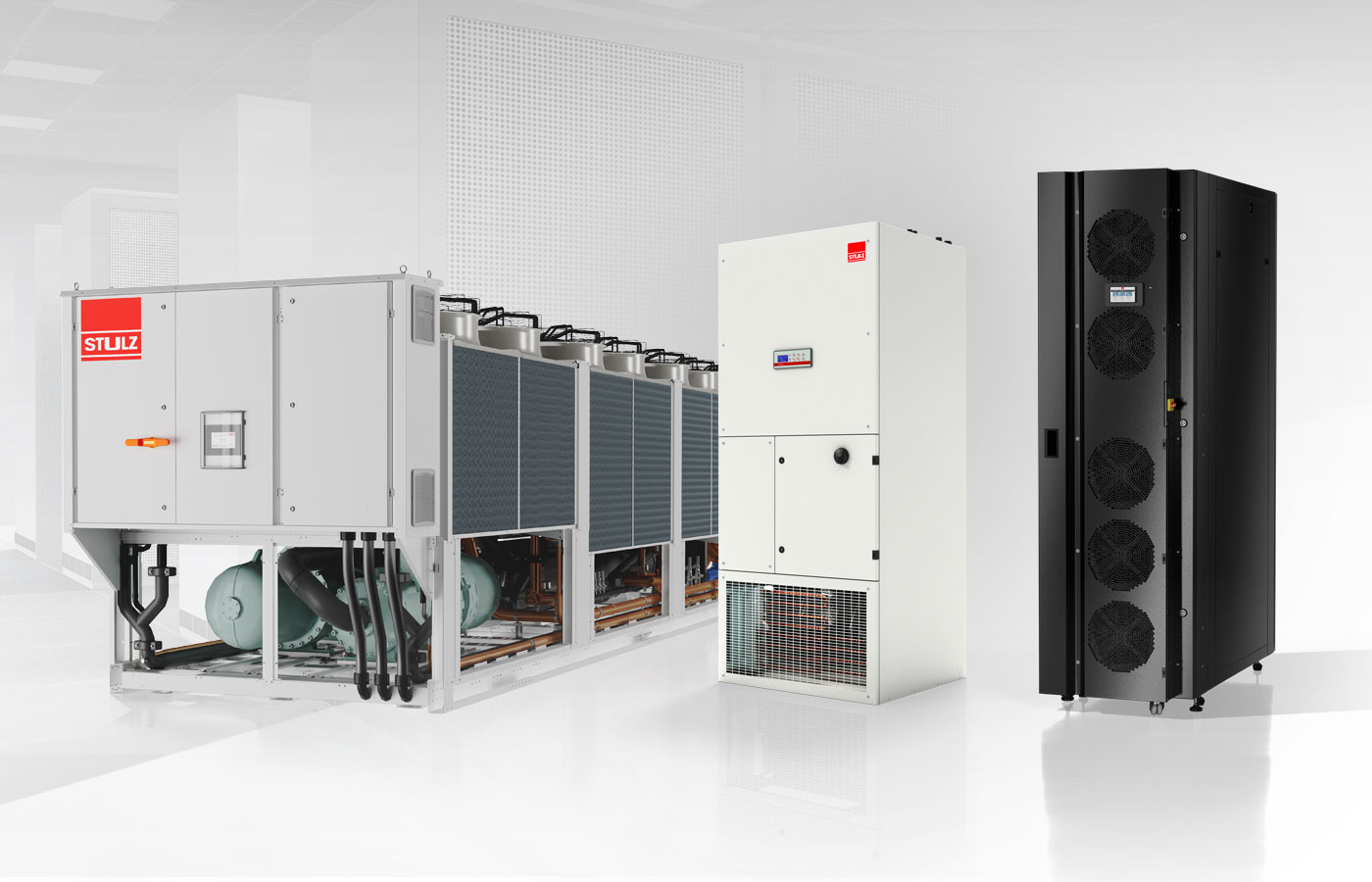
Explore the full range of data centre cooling products