STULZ worldwide

Liquid Cooling Immersion Tank

Liquid Immersion Cooling Tank

High-Density Immersion Cooling Solution For Future-Proof Data Centres

With growing data demands and rising server rack heat density in modern data centres, efficient cooling is more critical than ever. Immersion cooling offers an effective solution for heat dissipation, helping data centre operators address the challenges of increasing energy consumption and space limitations.

Our Liquid Cooling Immersion Tank operates at higher FWS and TCS temperatures, enhancing energy efficiency and reducing both partial PUE (pPUE) and overall PUE for the entire data center. With a proprietary tank design that ensures optimal coolant flow and thermal management, our systems require only half the space of traditional air cooling solutions.

Liquid Cooling Data Center Scalability Compact Unit

Key Benefits and Features of Our Liquid Cooling Immersion Tank
Benefits & Features
Technical Data
Liquid Cooling Immersion Tank
  • PUE Efficiency: PUE of 1.07 – 1.15 thanks to high operating temperatures
  • Advanced Control: State-of-the-art control and monitoring for maximal efficiency and reliability
  • Uniform Liquid Distribution: Tank design ensures even liquid flow, preventing hotspots in all conditions
  • High-quality Piping: Complete stainless steel piping with Victaulic connections for leak-proof operation
  • Biometric Security: Enhanced security with biometric access control
  • Precise Level Control: Flow level sensors maintain optimal liquid levels, with an integrated buffer tank automatically adjusting to restore nominal levels
  • Space-Saving Design: IT patch panel integrated within the tank casing, eliminating the need for additional space
  • Mobility Features: Equipped with leveling wheels for easy movement and adjustment on uneven terrain
  • Active Alarm System: LED lighting for clear alarm indications


Request

Remarks:
Additional capacities and technical data for customized solutions are available upon request.

Request

How the STULZ Liquid Cooling Immersion Tank Works

Integrated CDU

Coolant Distribution Units (CDUs) separate the Technology Cooling System from the Facilities Water System, reducing the risk of leaks and cross-contamination for greater system reliability.

Our Liquid Cooling Immersion Tank features an integrated CDU, offering compact, space-saving cooling for smaller capacities. For larger capacities, the STULZ CyberCool CMU coolant distribution unit ensures efficient heat transfer across the entire system.

the Technology Cooling System and the Facilities Water System

Precise control for greater reliability

Thanks to its flexible and precise control, the Liquid Cooling Immersion Tank ensures maximum reliability during continuous operation. In addition, to achieve the highest standards of reliability and usability, STULZ develops the controller in-house, ensuring that software, hardware and liquid cooling units are perfectly harmonized.


Other advantages

  • User-friendly 7” touchscreen display with two-level password protection for easy operation
  • Primary PICV adjusts based on TCS loop supply coolant temperature to maintain the setpoint (optional PICV modulates based on TCS loop return coolant temperature)
  • Adjustable pump switchover time, typically set to 8 hours
  • Coolant level sensors for real-time monitoring
  • Temperature is monitored at different points in the tank and displayed on the touchscreen
  • PDU power usage is monitored and displayed on the touchscreen
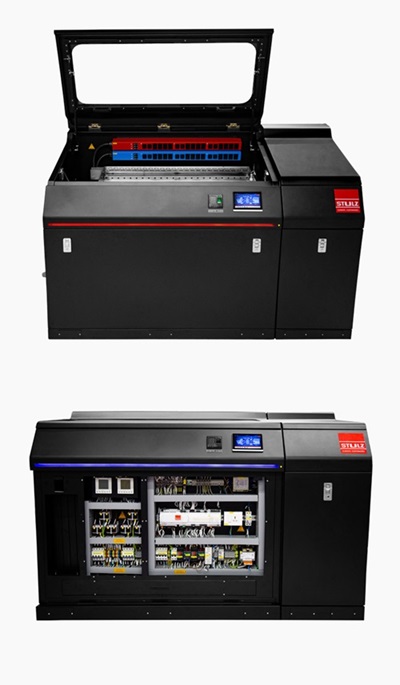
Precise and flexible control units of the Liquid Cooling Immersion Tank from STULZ

Climate. Customized.

Standard and custom built options

We offer both standard and custom-built solutions to optimize space in data centers. For customers with capacity requirements exceeding 100 kW, we provide customized tank designs tailored to meet specific needs.

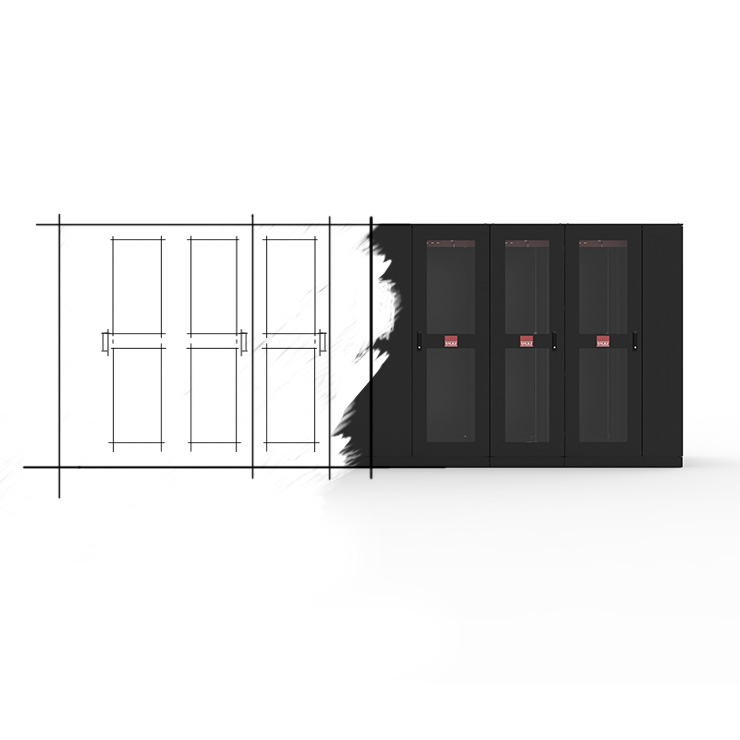
Customizability of Liquid Immersion Cooling Tank

Fast service and maintenance

Our trained and experienced STULZ Oceania sales and service teams support customers across Australia and New Zealand, enabling fast response times and reliable local support.

  • Front access to the tank and side access to the CDU for easy maintenance of all components
  • All CDU casing panels can be opened during critical maintenance (e.g., for plate heat exchanger servicing)
  • Optional server lifting equipment for easier server lifting and maintenance
  • Universal power socket included for powering electronic equipment during maintenance
Service for Liquid Cooling Immersion Tank
Professional service worldwide

Fast response times and regular trainings to ensure high quality of our products

Liquid Cooling Immersion Tank Brochure Thumbnail

Need more information?

Download our brochure!

  • Download

Get in touch

Do you have questions about our solutions or need technical advice?


Our experts will be happy to assist you with a thorough analysis and competent advice.

Contact us

Learn more about Liquid Cooling

Liquid Cooling solutions

Combining air cooling and liquid cooling with CyberCool CMU

Coolant Distribution Unit: CyberCool CMU

STULZ is international

Close to you around the world

With 9 production sites and 24 subsidiaries in Africa, America, Asia, Europe and Oceania, the company is at your side at all times. In addition, STULZ has exclusive agreements with numerous sales and service partners on all continents and is therefore represented in over 140 countries around the globe. With this global network of partners and independent manufacturers for direct chip and immersion cooling, STULZ is the right partner for all liquid cooling requirements.


Interest
Åland Afghanistan Albania Algeria American Samoa Andorra Angola Anguilla Antarctica Antigua and Barbuda Argentina Armenia Aruba Australia Austria Azerbaijan Bahrain Bangladesh Barbados Belarus Belgium Belize Benin Bermuda Bhutan Bolivia Bonaire, Sint Eustatius and Saba Bosnia and Herzegovina Botswana Bouvet Island Brazil British Indian Ocean Territory British Virgin Islands Brunei Bulgaria Burkina Faso Burundi Cambodia Cameroon Canada Cape Verde Cayman Islands Central African Republic Chad Chile China Christmas Island Cocos (Keeling) Islands Colombia Comoros Congo Congo-Brazzaville Cook Islands Costa Rica Croatia Cuba Curaçao Cyprus Czech Republic Côte d’Ivoire Denmark Djibouti Dominica Dominican Republic Ecuador Egypt El Salvador Equatorial Guinea Eritrea Estonia Eswatini Ethiopia Falkland Islands Faroes Fiji Finland France French Guiana French Polynesia French Southern Territories Gabon Gambia Georgia Germany Ghana Gibraltar Greece Greenland Grenada Guadeloupe Guam Guatemala Guernsey Guinea Guinea-Bissau Guyana Haiti Heard Island and McDonald Islands Honduras Hong Kong SAR of China Hungary Iceland India Indonesia Iran Iraq Ireland Isle of Man Israel Italy Jamaica Japan Jersey Jordan Kazakhstan Kenya Kiribati Kosovo Kuwait Kyrgyzstan Laos Latvia Lebanon Lesotho Liberia Libya Liechtenstein Lithuania Luxembourg Macao SAR of China Madagascar Malawi Malaysia Maldives Mali Malta Marshall Islands Martinique Mauritania Mauritius Mayotte Mexico Micronesia Moldova Monaco Mongolia Montenegro Montserrat Morocco Mozambique Myanmar Namibia Nauru Nepal Netherlands New Caledonia New Zealand Nicaragua Niger Nigeria Niue Norfolk Island Northern Marianas North Korea North Macedonia Norway Oman Pakistan Palau Palestine Panama Papua New Guinea Paraguay Peru Philippines Pitcairn Islands Poland Portugal Puerto Rico Qatar Reunion Romania Russia Rwanda Saint Barthélemy Saint Helena, Ascension and Tristan da Cunha Saint Kitts and Nevis Saint Lucia Saint Martin Saint Pierre and Miquelon Saint Vincent and the Grenadines Samoa San Marino Saudi Arabia Senegal Serbia Seychelles Sierra Leone Singapore Sint Maarten Slovakia Slovenia Solomon Islands Somalia South Africa South Georgia and the South Sandwich Islands South Korea South Sudan Spain Sri Lanka Sudan Suriname Svalbard Sweden Switzerland Syria São Tomé e Príncipe Taiwan Tajikistan Tanzania Thailand The Bahamas Timor-Leste Togo Tokelau Tonga Trinidad and Tobago Tunisia Turkey Turkmenistan Turks and Caicos Islands Tuvalu Uganda Ukraine United Arab Emirates United Kingdom United States United States Minor Outlying Islands Uruguay US Virgin Islands Uzbekistan Vanuatu Vatican City Venezuela Vietnam Wallis and Futuna Western Sahara Yemen Zambia Zimbabwe
Data Center IT/Telecommunications Consulting/Engineering Healthcare Warehouse/Manufacturing Construction Other
Personal data
Mrs. Mr. Diverse
I want to talk to sales. I need technical support/service. I want to order parts / need a quote. I am looking for a job/interested in recruitment. I need a general information / other.
Yes, in the next 6 months Yes, in the next year No
I agree that my data will be forwarded to an authorized STULZ subsidiary or partner responsible for my country to answer my request.
I have read and accepted the Data Protection Declaration . *

Captcha

*Mandatory field

FAQs

What is a liquid cooling immersion tank?

A liquid cooling immersion tank is a cooling system where IT equipment, such as servers, is fully submerged in a non-conductive liquid. Heat generated by the equipment is transferred directly to the liquid, allowing for highly efficient heat removal compared to traditional air-cooled systems.


How does immersion cooling improve energy efficiency in data centres?

Immersion cooling enables operation at higher Facilities Water System (FWS) and Technology Cooling System (TCS) temperatures, which improves overall energy efficiency. This helps reduce both partial PUE (pPUE) and total PUE, lowering cooling energy consumption across the data centre.

What role does the integrated CDU play in the immersion cooling system?

The integrated Coolant Distribution Unit (CDU) separates the Technology Cooling System from the Facilities Water System, reducing the risk of leaks and cross-contamination. This improves system reliability while enabling precise control of coolant flow and temperature.

How much space does an immersion cooling tank require compared to air cooling?

The STULZ Liquid Cooling Immersion Tank requires approximately half the space of traditional air-cooled solutions. Its compact design allows higher cooling capacity within a smaller footprint, making it well suited to high-density data centre environments.

Is the Liquid Cooling Immersion Tank suitable for high-density and AI workloads?

Yes. Immersion cooling is particularly well suited to high-density racks, AI workloads and high-performance computing environments where heat loads are extremely high and traditional air cooling becomes inefficient or impractical.

Are standard and custom immersion cooling solutions available?

STULZ offers both standard immersion tank solutions and custom-built designs. For applications exceeding 100 kW per system, customised tanks can be developed to meet specific capacity, layout and operational requirements.